

The way people search for information online is changing rapidly. For years, Google Search was the default starting point whenever people wanted an answer, product, service, location, or solution. Users would type a few keywords, scan search results, open multiple websites, and compare information before making a decision.
Today, that process is becoming more conversational. Instead of searching for short keywords, users increasingly ask complete questions and expect direct, contextual answers. Tools such as ChatGPT and other AI search engines are changing how people discover, evaluate, and consume information.
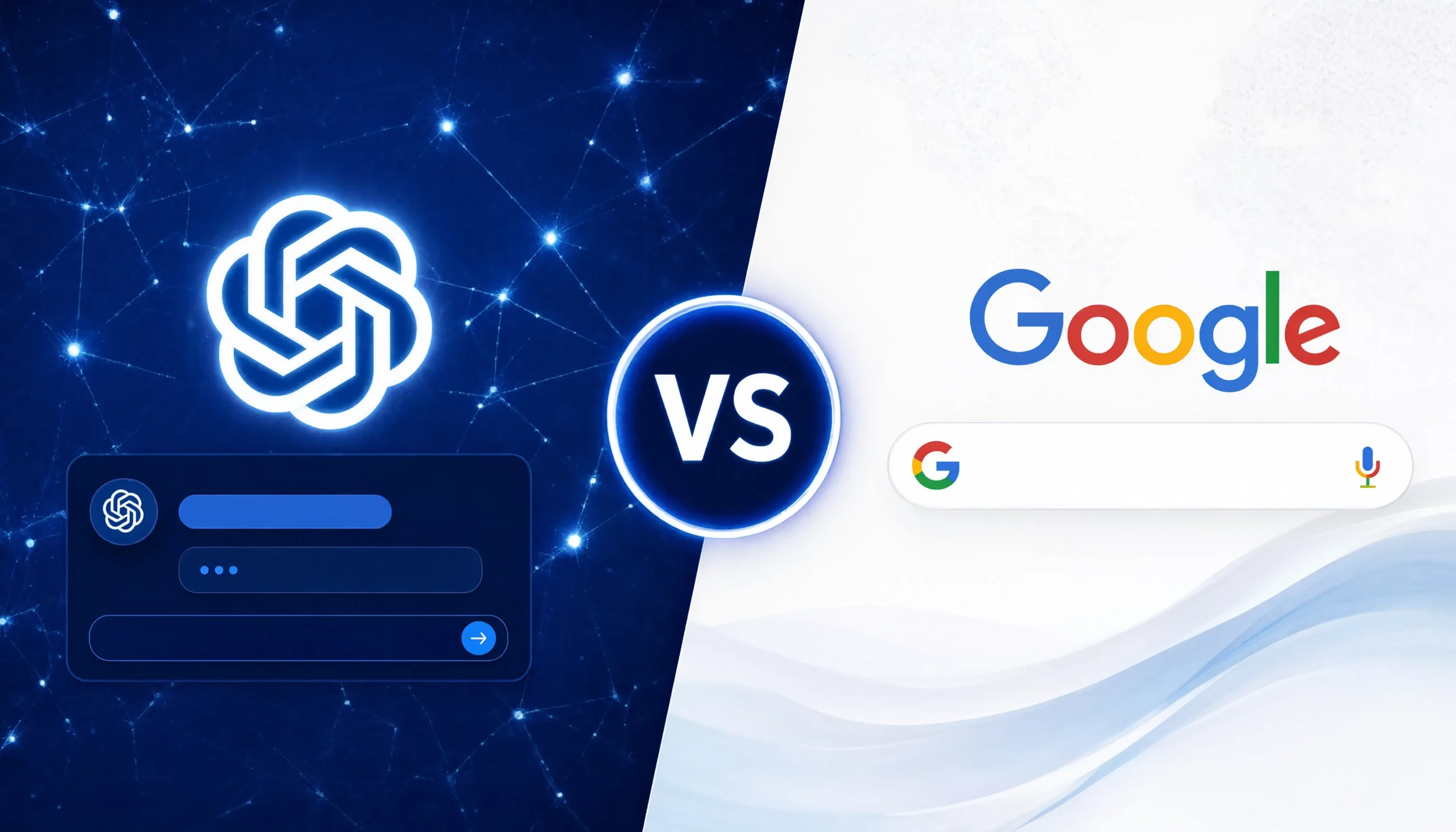
This raises an important question: ChatGPT vs Google Search – which one will people choose in the future?
The answer is not simply one or the other. Both are evolving, and the bigger change is happening in the way people search.
ChatGPT vs Google Search: What’s the Difference?
The traditional Google Search experience is primarily designed to help users discover information across the web. A typical search might show websites, images, videos, maps, shopping results, advertisements, and other features.
ChatGPT, on the other hand, provides a conversational experience. Users can describe what they need in natural language, ask follow-up questions, request comparisons, and refine the answer without starting a completely new search.
ChatGPT can also search the web when current information is needed and provide links to relevant sources.
For example, instead of searching:
“best digital marketing agencies Kerala”
a user might ask:
“I run a small business in Kerala. Which type of digital marketing strategy should I focus on first, and what should I look for when choosing an agency?”
The second query provides more context and expects a more personalized response.
This difference represents one of the biggest changes in modern search behaviour.
Google Search vs ChatGPT: How Users Are Searching Differently
The debate around Google Search vs ChatGPT is not only about technology. It is also about user expectations.
Traditional search behaviour often looks like this:
Search → Browse → Compare → Click → Read → Decide
AI-assisted search can look more like:
Ask → Receive an answer → Ask a follow-up → Refine → Decide
This makes the search journey shorter and more interactive.
Google itself has been moving toward this conversational model. Its AI Mode allows users to ask longer and more complex questions, continue with follow-up queries, and explore information through AI-generated responses and web links. Google reported that early AI Mode users were asking queries two to three times longer than traditional searches.
This means search engines are no longer simply interpreting keywords. They are increasingly trying to understand intent, context, and the complete problem behind a query.
Why Are People Moving Towards AI Search?
One major reason is convenience.
Imagine someone wants to plan a three-day trip. With traditional search, they might search for hotels, attractions, restaurants, travel routes, costs, and activities separately.
With AI search, they can begin with one detailed question and continue refining it.
For example:
“Plan a three-day budget-friendly trip to Kerala for a family, including places to visit, food options, and a practical itinerary.”
The user can then ask:
“Make it suitable for children.”
And then:
“Reduce the travel time and suggest better accommodation areas.”
This conversational process makes information discovery feel more like a discussion than a search.
AI search is particularly useful for complex, exploratory, comparison-based, and research-oriented queries.
ChatGPT Search vs Google Search: Which Is Better?
There is no universal winner in the ChatGPT search vs Google Search comparison because the better option depends on the user’s intent.
Google Search is still useful for:
- Finding specific websites
- Local businesses and locations
- Breaking news
- Shopping and product discovery
- Maps and directions
- Comparing multiple web sources
- Navigating directly to known websites
- Finding original articles and documents
ChatGPT can be useful for:
- Explaining complicated topics
- Summarizing information
- Comparing different options
- Brainstorming ideas
- Asking follow-up questions
- Creating personalized plans
- Understanding a topic through conversation
- Combining information into a structured response
However, AI-generated answers should still be verified, especially for important decisions. ChatGPT itself notes that search results and citations can sometimes be incomplete, outdated, or incorrect, so checking the cited sources remains important.
AI Search vs Google: Is Google Being Replaced?
The idea of AI search vs Google is sometimes presented as a competition where one technology will completely replace the other. The reality is more complicated.
Google itself is becoming an AI-powered search engine.
Google introduced AI Overviews and AI Mode to make Search more conversational and capable of handling complex queries. In 2026, Google stated that AI Mode had surpassed one billion monthly active users globally and that AI Mode queries were more than doubling each quarter since launch.
This means the future may not be about choosing between traditional search and AI search. Instead, traditional search engines are incorporating AI while standalone AI platforms are incorporating web search.
The boundaries between the two are becoming increasingly blurred.
The Rise of AI Search Engines
The growth of AI search engines is changing the concept of online discovery.
Traditional search engines generally return a collection of links. AI-powered search experiences increasingly attempt to understand those links, extract useful information, and present it in a conversational format.
This creates a new challenge for businesses.
Previously, the main question was:
“How can my website rank on Google?”
Now businesses also need to consider:
“How can my brand become visible when people ask AI platforms about products, services, or solutions in my industry?”
This is where SEO is expanding beyond traditional rankings.
Businesses need to think about search visibility across Google, AI platforms, answer engines, voice search, and other emerging discovery channels.
What Does This Mean for SEO?
The changing search behaviour does not mean SEO is dead. Instead, SEO is becoming broader.
Search engines and AI systems need reliable information to understand businesses and provide useful answers. This makes several factors increasingly important:
1. Search Intent
Content should answer the actual question behind the search rather than simply repeating keywords.
2. Helpful Content
Articles should provide genuine information, examples, explanations, and solutions instead of being created only to target search terms.
3. Topical Authority
Businesses should consistently demonstrate expertise within their industry rather than publishing disconnected articles.
4. Structured Information
Clear headings, FAQs, structured data, concise explanations, and well-organized content can make information easier for search systems to understand.
5. Brand Authority
Strong brand mentions, reviews, credible references, expert content, and a consistent online presence can contribute to how a business is understood and trusted.
6. Local SEO
For businesses serving specific locations, maintaining accurate local information, Google Business Profile signals, reviews, and location-focused content remains important.
The goal is no longer simply to rank for one keyword. It is to build a digital presence that can be discovered across multiple search environments.
How Should Businesses Adapt to Changing Search Behaviour?
Businesses should start thinking beyond traditional keyword rankings.
Instead of creating content only around phrases such as “digital marketing agency Kerala,” businesses can build content around the questions potential customers actually ask.
For example:
- What does a digital marketing agency do?
- How much does digital marketing cost?
- Which marketing strategy is best for a small business?
- SEO vs Google Ads: which is better?
- How can a local business generate more leads online?
- What should I look for when choosing a marketing agency?
This approach creates content that is useful for people while also giving search and AI systems clearer information about the brand.
Google’s recent AI Search developments also show that users are asking more complex questions and exploring topics through conversational interactions.
How Bizcat Helps Brands Adapt to the New Search Era?
As search behaviour evolves, businesses need more than traditional digital marketing. They need a strategy that connects branding, SEO, content, technology, and customer intent.
Bizcat positions itself as Kerala’s first brand transformation agency, combining strategic consulting, branding, digital solutions, SEO, web development, and content-driven execution.
As the best brand transformation agency in Kerala, we focus on helping businesses build stronger and more relevant digital identities. Our SEO approach includes traditional SEO along with emerging areas such as Generative Engine Optimization (GEO) and Large Language Model Optimization (LLMO) to improve visibility across search engines and AI-driven platforms.
This broader approach is important because future customers may discover a business through Google Search, AI search, social platforms, maps, recommendations, or conversational AI.
A strong brand therefore needs to be visible and understandable across multiple digital touchpoints.
The Future of Search Is Conversational
The biggest change is not that people are abandoning Google and moving entirely to ChatGPT.
Instead, search behaviour itself is becoming more conversational, contextual, and intent-driven.
People want fewer fragmented searches and more useful answers. They want to ask complex questions, continue conversations, compare options, and reach decisions faster.
Google is adapting by integrating AI into Search, while ChatGPT and other AI platforms are bringing web search into conversational experiences. Google has also emphasized that its AI Search developments are designed to connect users with relevant websites and original content, rather than eliminating the web.
For businesses, this means the future of search visibility will depend on more than rankings.
It will depend on being useful, credible, relevant, authoritative, and easy for both people and AI systems to understand.
Conclusion
The ChatGPT vs Google Search debate represents a much bigger transformation in digital behaviour. Google remains a powerful gateway to the web, while ChatGPT has introduced a more conversational way of finding and understanding information. At the same time, Google itself is rapidly integrating AI into its search experience.
The real shift is from keyword-based searching to intent-based discovery.
For businesses, this is the time to rethink their digital strategy. Investing in high-quality content, SEO, brand authority, structured information, local visibility, and AI-focused optimization can help brands remain discoverable as search continues to evolve.
The future may not belong exclusively to Google or ChatGPT. It will belong to brands that understand how people search, how AI interprets information, and how customers make decisions in an increasingly AI-driven digital world.
FAQs
1. Is ChatGPT better than Google Search?
ChatGPT can be better for conversational questions, explanations, comparisons, and personalized answers, while Google Search remains highly useful for websites, local businesses, news, maps, shopping, and discovering multiple sources.
2. What is the difference between ChatGPT and Google Search?
Google Search primarily helps users discover information across websites and other online sources, while ChatGPT provides a conversational experience where users can ask questions, receive answers, and continue with follow-up queries.
3. Will ChatGPT replace Google Search?
ChatGPT is changing how people search for information, but it is unlikely that Google Search will simply disappear. Both platforms are evolving, with Google increasingly integrating AI into its search experience.
4. What is AI search?
AI search uses artificial intelligence to understand the context and intent behind a query and provide more direct, conversational, and summarized responses instead of relying only on traditional lists of search results.