

Performance marketing is all about driving measurable results. But simply generating clicks, leads, or sales isn’t enough-businesses also need to understand how effectively their marketing budget is being used and whether it is contributing to profitability. This is where ROAS and ROI become essential. Although both metrics measure returns, they serve different purposes and provide different insights into marketing performance.
Although ROAS and ROI are often used interchangeably, they measure different aspects of business performance. Understanding the ROAS vs ROI relationship can help marketers make better decisions about advertising budgets, campaign performance, and overall business profitability.
What Is ROAS in Performance Marketing?
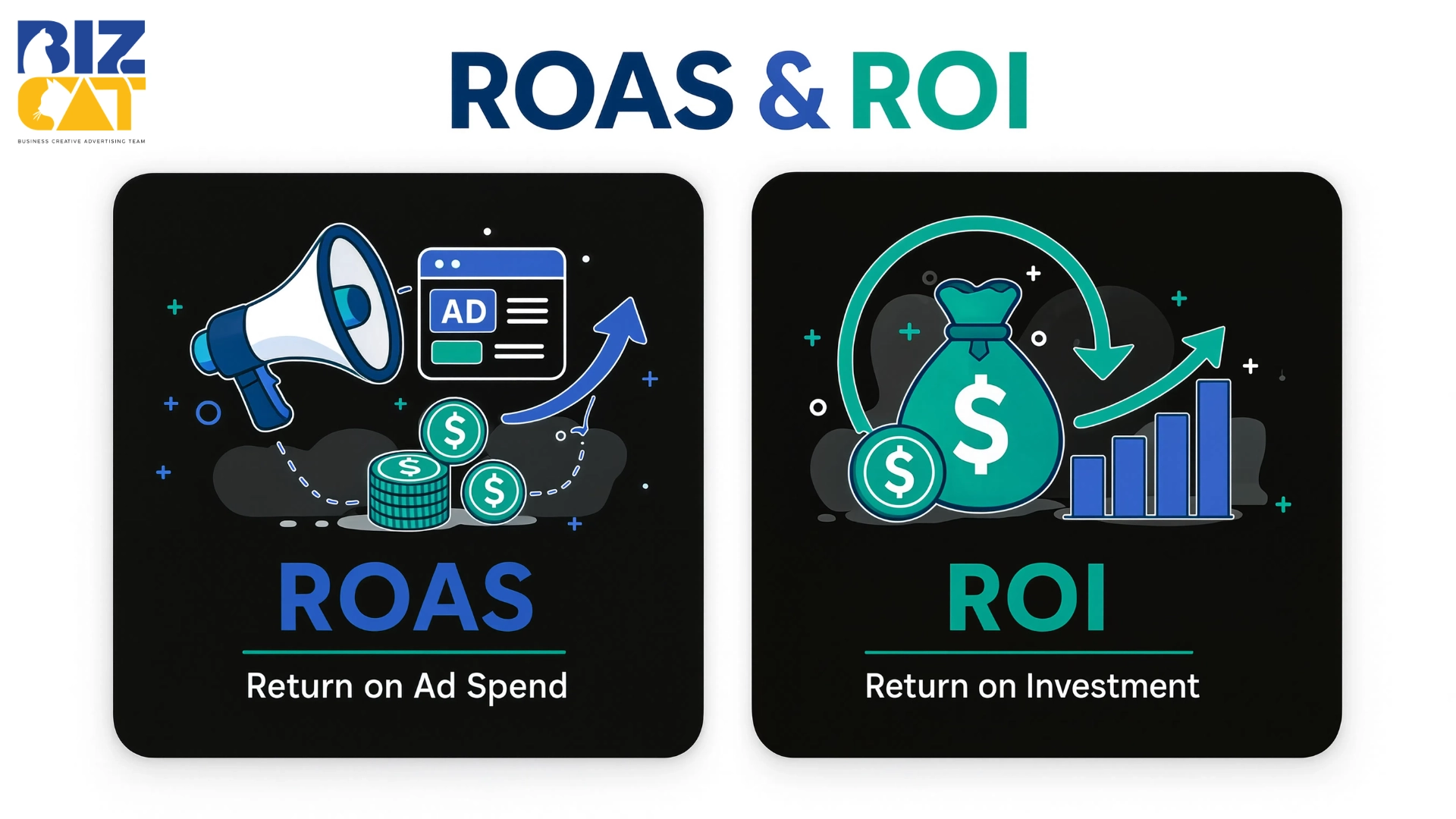
ROAS in performance marketing stands for Return on Ad Spend. It measures how much revenue a business generates for every amount spent specifically on advertising.
ROAS Formula
ROAS = Revenue Generated from Ads ÷ Advertising Cost
For example, if a business spends ₹50,000 on an advertising campaign and generates ₹2,00,000 in revenue, the ROAS is:
₹2,00,000 ÷ ₹50,000 = 4
This means the business generated ₹4 in revenue for every ₹1 spent on advertising.
ROAS is particularly useful for evaluating individual campaigns, platforms, ad sets, and creatives. It helps marketers identify which advertising activities are generating stronger revenue returns.
What Is ROI in Performance Marketing?
ROI in performance marketing stands for Return on Investment. Unlike ROAS, ROI looks beyond advertising costs and considers the overall investment and associated costs involved in generating a return.
ROI Formula
ROI = (Net Profit ÷ Total Investment) × 100
For example, suppose a company invests ₹1,00,000 in marketing and related expenses and generates ₹1,50,000 after accounting for costs. If the resulting profit is ₹50,000:
ROI = (₹50,000 ÷ ₹1,00,000) × 100 = 50%
ROI therefore provides a broader view of whether an investment is actually profitable.
ROAS vs ROI: Key Difference
The main difference between ROAS and ROI is what each metric measures.
ROAS focuses specifically on advertising efficiency, while ROI measures overall profitability.
ROAS answers:
“How much revenue did our advertising generate compared with what we spent on ads?”
ROI answers:
“How profitable was our overall investment after considering the relevant costs?”
This makes ROAS particularly valuable for campaign-level optimization, while ROI is more useful for evaluating the financial success of a broader marketing initiative or business investment.
ROAS vs ROI in Performance Marketing
When comparing ROAS vs ROI in performance marketing, marketers should understand that the two metrics serve different purposes.
| ROAS | ROI |
| Measures return from advertising spend | Measures return from overall investment |
| Primarily focuses on ad revenue | Focuses on profitability |
| Useful for campaign optimization | Useful for business-level decision-making |
| Usually expressed as a ratio | Usually expressed as a percentage |
| Helps compare advertising channels | Helps evaluate overall financial performance |
For example, a campaign may have a ROAS of 5x, meaning it generated ₹5 in revenue for every ₹1 spent on ads. However, that does not automatically mean the business made a strong profit. Product costs, salaries, agency fees, logistics, discounts, and other expenses can significantly affect the final ROI.
ROAS and ROI Difference: Why Both Matter?
The ROAS and ROI difference becomes especially important when businesses are scaling their marketing campaigns.
A high ROAS can indicate that an advertising campaign is generating strong revenue relative to ad spend. However, if the business has high operational or product costs, the actual profit may be much lower.
Similarly, a campaign with a lower ROAS may still contribute to a healthy overall ROI if it brings valuable customers, repeat purchases, or strong long-term revenue.
That is why marketers should avoid evaluating campaign success using only one metric.
When Should You Use ROAS?
ROAS is especially useful when you want to:
- Compare the performance of different advertising campaigns
- Identify profitable ad sets and creatives
- Compare platforms such as Google Ads and Meta Ads
- Decide where to increase or reduce advertising budgets
- Monitor revenue generated from paid advertising
- Optimize campaigns based on measurable returns
For example, if one campaign has a ROAS of 2x and another has a ROAS of 6x, the second campaign is generating more revenue relative to its advertising cost, assuming the measurements are comparable.
When Should You Use ROI?
ROI is more appropriate when you want to:
- Evaluate overall marketing profitability
- Understand the financial impact of an investment
- Account for costs beyond advertising spend
- Compare marketing investments with other business investments
- Assess whether a marketing strategy is contributing to profitable growth
ROI provides a broader financial perspective and can help business owners understand whether their marketing efforts are creating sustainable value.
ROAS vs ROI Example
Consider an e-commerce company that spends ₹1,00,000 on advertising.
The campaign generates ₹5,00,000 in revenue.
ROAS
ROAS = ₹5,00,000 ÷ ₹1,00,000 = 5x
The campaign generated ₹5 in revenue for every ₹1 spent on advertising.
However, assume the business also incurred ₹3,00,000 in product and other relevant costs.
The actual profit after total costs would be significantly lower than the revenue figure.
This demonstrates why ROAS vs ROI should not be treated as a choice between two competing metrics. Instead, they should be used together to understand both advertising efficiency and overall profitability.
How to Improve ROAS and ROI
Improving these metrics requires more than simply increasing ad budgets. Marketers should focus on improving the complete customer journey.
1. Target the Right Audience
Precise audience targeting can help reduce wasted ad spend and improve the quality of traffic and leads.
2. Optimize Ad Creatives
Testing different headlines, visuals, videos, offers, and calls to action can help identify creatives that generate stronger engagement and conversions.
3. Improve Landing Pages
A well-optimized landing page can turn more visitors into leads or customers, improving the efficiency of paid campaigns.
4. Track Conversions Accurately
Proper conversion tracking is essential for understanding which campaigns are actually generating results.
5. Optimize the Customer Journey
Improving the journey from ad click to purchase can increase conversion rates and revenue without necessarily increasing advertising spend.
6. Focus on Customer Lifetime Value
A customer may generate revenue multiple times after the first purchase. Considering customer lifetime value can provide a more complete picture of long-term marketing performance.
ROAS vs ROI: Which Metric Is More Important?
There is no single answer to which metric is better.
ROAS is more useful when the primary goal is to measure and optimize advertising performance.
ROI is more useful when the goal is to understand overall profitability and the financial impact of an investment.
The best approach is to use both. ROAS helps marketers optimize paid campaigns, while ROI helps businesses understand whether those marketing efforts are ultimately contributing to profitable growth.
Measure Performance with Bizcat
At Bizcat, we believe performance marketing should be driven by measurable outcomes, not assumptions. As the best performance marketing agency in Calicut, we help businesses build data-driven campaigns focused on meaningful business results.
We use performance marketing strategies to reach the right audiences, generate qualified leads, optimize advertising campaigns, and track important performance marketing KPIs. By analyzing metrics such as ROAS, ROI, conversion rates, cost per lead, and customer acquisition costs, we help businesses make smarter marketing decisions.
Our approach combines strategy, creative optimization, audience targeting, conversion tracking, and continuous campaign analysis to create campaigns that are designed for measurable growth.
Conclusion
Understanding the difference between ROAS and ROI is essential for making informed performance marketing decisions.
ROAS tells you how efficiently your advertising spend is generating revenue, while ROI gives you a broader understanding of profitability after considering the overall investment and associated costs.
Rather than focusing on ROAS vs ROI as competing metrics, businesses should use both together. ROAS can guide campaign optimization, while ROI can help determine whether marketing investments are creating sustainable business value.
When these metrics are tracked consistently and analyzed alongside other digital marketing metrics, businesses can build more efficient campaigns, allocate budgets more effectively, and make performance marketing a measurable driver of growth.
FAQs
Is ROAS better than ROI for performance marketing?
Neither metric is universally better. ROAS is useful for measuring and optimizing advertising campaigns, while ROI provides a broader view of overall marketing profitability. Using both gives a more complete picture.
Can a campaign have high ROAS but low ROI?
Yes. A campaign can generate strong revenue compared with ad spend but still have low ROI if other costs, such as product costs, salaries, logistics, agency fees, or operational expenses, are high.
Why is ROAS important in performance marketing?
ROAS helps marketers understand how efficiently advertising budgets are generating revenue. It can be used to compare campaigns, identify high-performing ads, and make better budget allocation decisions.
Should businesses track both ROAS and ROI?
Yes. Tracking both ROAS and ROI allows businesses to evaluate advertising efficiency as well as overall profitability, leading to better performance marketing decisions.